
On this page
To measure an opening for glass, record the width at the top, middle and bottom, then the height at both sides, and order to the smallest of each. Keep every reading, check both diagonals, and mark every socket or pipe to its centre. On shower and bath glass you give us the opening and the configurator works out the glass; on other products the field labels say which figure they want.
What do I need before I start?
A tape measure, a pencil and our free measuring pack. The pack has three pages: a measuring guide, a record sheet for a rectangular panel with the diagonals check, and a 10 mm tracing grid for odd shapes. Print it at 100% scale, never "fit to page", and check the 100 mm scale bar against a ruler before you use any template on it.
Work in millimetres only. A rounded centimetre turns into a gap that needs packing on site.
How do I measure the opening?
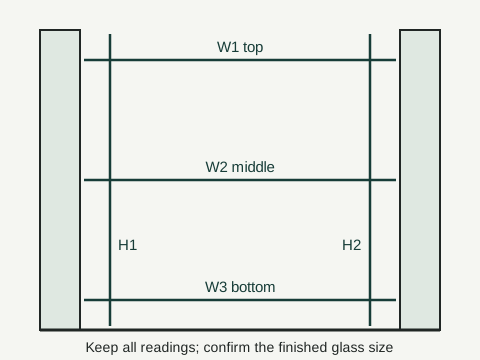
Step 1: Measure the width at three heights
Measure across the top, the middle and the bottom of the opening. The middle is where a frame or wall usually bows. Write all three down and use the smallest, without discarding the others.
Step 2: Measure the height on both sides
Measure top to bottom down the left side and the right side. Use the smaller, and keep both readings.
Step 3: Check the diagonals
Measure corner to corner, both ways. If the two diagonals differ by more than 3 mm, the opening is out of square. Write both down and tell us when you order. Do not average them.
Step 4: Decide: opening size or glass size
On every shower and bath layout, give the opening: the configurator takes off the channel, hinge gap and seals and shows the breakdown. On other products, read the field label. If you supply a finished glass size, say so.
Step 5: Measure obstructions to their centre
Sockets, pipes, taps and tiles that overlap the opening need a cut-out. Measure to the centre of each one from the same two edges every time, and say which two edges those are.
Step 6: Enter the numbers in the configurator
Type your sizes into the configurator. A drawing of your exact panel appears as you type, and the workshop cuts from that drawing. Check it before you order.
Opening size or glass size: why does it matter?
They are both valid numbers, but they are not the same number. If you take a channel allowance off a shower opening yourself, the configurator takes it off again and the glass comes out too small. Elsewhere, mark your figure clearly as the opening or the glass. The one place it is usually safe to give the exact finished size is a table top, where you measure the base and add the overhang you want. Read opening size or glass size for the allowances on each product.
How accurate do my measurements need to be?
We cut to plus or minus 2 mm unless your drawing shows a different figure. Your measuring needs to be at least that careful, which is why three widths and two heights matter: one figure taken in the middle can miss a bow or a slope of several millimetres. Before anything is made, you see a dimensioned drawing and tick to confirm it at checkout. Read your drawing and checks for how that works.
What about odd shapes?
Trace the shape, or a cardboard template of it, onto page 3 of the measuring pack. Mark the overall width and height, photograph the sheet flat and square-on, and upload the photo through the template or CAD link under Rake. Our team prices it and confirms a CAD drawing before anything is cut. Read sending a template or drawing.
Are there guides for my product?
Yes. Each one covers the details for that job, such as the shower tray lip or the shadow gap at each end of a splashback:
When should I not measure it myself?
The measuring pack is our own workshop method, not a survey. If the opening is out of square or the glass is structural, have it measured on site before you order. You can book a measuring visit and we measure for you.
Where to go next
Download the measuring pack and take your measurements.
Questions we get asked
Should I round my measurements?
No. Measure in millimetres without rounding, and keep every reading.
My diagonals are different. What now?
If they differ by more than 3 mm, the opening is out of square. Write both diagonals down and tell us when you order, or book a measuring visit.
Can holes be added after the glass arrives?
Not in toughened glass. Every hole and cut-out is made before toughening, so measure your fittings and obstructions before you order.
What tolerance do you cut to?
Plus or minus 2 mm unless your drawing shows a different figure, and every order is confirmed with a dimensioned drawing before anything is made.
Contact the team with your order reference and the step you need help with, or search all help topics.